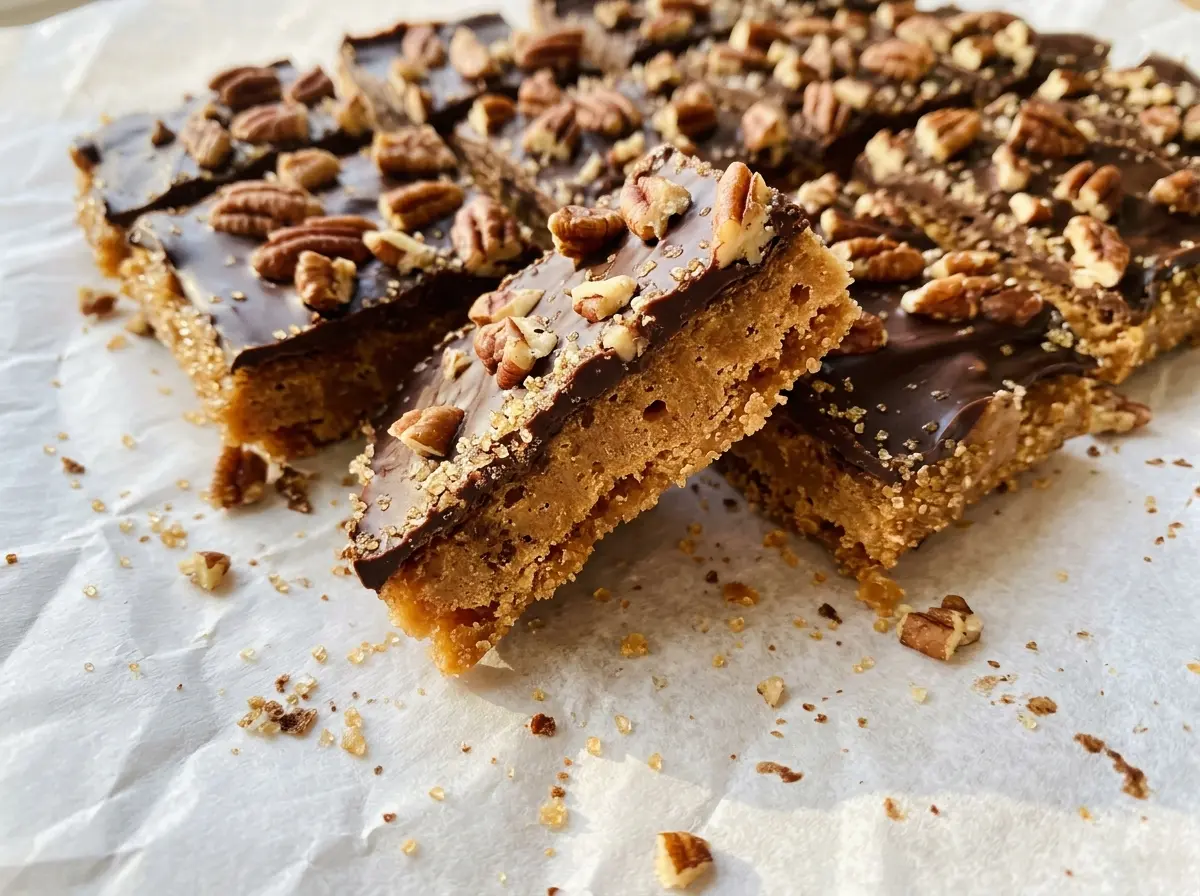
When butter and sugar turn into toffee, the mixture changes quickly near the end: a minute too soon can leave you with a chewy piece instead of that clean, brittle snap. I keep the parchment-lined pan ready before the saucepan goes on the burner, because there isn’t much time to pause once the toffee reaches its target temperature. These Melt In Your Mouth Toffee pieces pair a crisp buttery base with a thin chocolate layer and finely chopped almonds.
The thermometer takes the guesswork out of candy making. Rather than judging the color alone, I cook the mixture to 300°F, then take it off the heat and stir in the vanilla. The chocolate gets a short rest on the hot toffee before you spread it, which lets the chips soften without a separate melting step. Once the almonds are pressed into the chocolate and the slab is completely firm, you can break it into pieces with crisp edges and a satisfying crunch.
Kitchen Note
The vanilla goes into a pan of very hot candy, so it may sputter when you stir it in. Keep your face and hands back from the pan, and stir carefully before you pour.
Save Melt In Your Mouth Toffee for a homemade treat with crisp buttery candy, melted semisweet chocolate, and a generous almond crunch.
Why 300°F Is the Difference Between Snappy Toffee and Chewy Candy
Toffee depends on how far the sugar mixture cooks, not just how dark it looks. At 300°F, the mixture reaches the hard-crack stage, which gives the finished candy its brittle break. Stop short and the toffee can stay softer or chewy; cook it too far and the sugar can darken into a bitter, scorched taste. The thermometer gives you a clear endpoint while the color is changing fast.
Use a candy thermometer attached to the heavy-bottomed saucepan, and keep the mixture moving over medium heat as it cooks. A heavy base spreads heat more evenly than a thin pan, helping limit hot spots while the butter and sugar come up to temperature. If the thermometer bulb rests against the bottom of the pan, it can read hotter than the candy itself, so position it in the mixture without letting it touch the metal. Plan on about 10 to 15 minutes, but let the temperature—not the clock—tell you when to stop.
What the Butter, Chocolate, and Almonds Each Bring to This Toffee

- Unsalted butter — Butter gives the candy its rich, rounded taste and helps form the toffee alongside the sugar. Unsalted butter lets you control the salt level. If salted butter is what you have, use it and leave out the fine salt; the finished candy will taste a little saltier.
- Granulated sugar and water — Plain granulated sugar gives this toffee its crisp structure, while the water helps the sugar and butter heat together at the start. Brown sugar changes the flavor and texture, so it isn’t a like-for-like swap here. No specialty sugar is needed.
- Fine salt and vanilla extract — Salt keeps the buttery sweetness from tasting flat, and vanilla rounds out the cooked-sugar flavor. Use a familiar pure or imitation vanilla extract; either works in this small amount. Stir it in carefully after removing the pan from the heat.
- Semisweet chocolate chips — Semisweet chocolate brings a gently bitter contrast to the sweet candy. Since the chips melt right on the hot toffee, choose chips you enjoy eating; there’s no need to melt them separately.
- Dry-roasted almonds — Their toasted flavor and crunchy texture balance the hard candy. Finely chopping them helps distribute the topping across the chocolate. If you’re using whole dry-roasted almonds, chop them before you start cooking so the hot toffee is ready to pour when it’s done.
From the Saucepan to the Snap: Building the Toffee in Four Stages
Get the Pan and Thermometer Ready
Line a 9×13-inch rimmed baking sheet with parchment before you cook anything. Combine the butter, sugar, water, and fine salt in a heavy-bottomed 3-quart saucepan, then attach the candy thermometer. Set the chopped almonds and chocolate chips nearby so you won’t have to search for them while the candy is hot. Starting with the pan prepared gives you a clear place to pour as soon as the toffee is ready.
Cook the Mixture to 300°F
Cook over medium heat, stirring constantly, until the thermometer reaches 300°F; this usually takes about 10 to 15 minutes. Keep stirring rather than leaving the saucepan unattended, and watch the temperature closely as it approaches the target. The mixture will be hot, so keep the spoon inside the pan and avoid splashing. Take the saucepan off the heat when it reaches 300°F.
Stir in Vanilla and Spread the Toffee
Carefully stir the vanilla into the hot mixture, then immediately pour it onto the prepared baking sheet. Spread it into an even layer while it’s still fluid. Work promptly, since the candy firms as it cools and an uneven layer means some pieces will be much thicker than others. Keep the saucepan steady as you pour to avoid splashes.
Melt the Chocolate and Let the Slab Set
Scatter the chocolate chips over the hot toffee and leave them in place for 2 minutes. Spread the softened chocolate over the surface, then sprinkle on the finely chopped almonds and gently press them into the chocolate. Leave the sheet at room temperature until the toffee is completely firm, about 2 hours. Break the set slab into pieces once it has cooled through.
Easy Ways to Change the Chocolate or Crunch
Use bittersweet chocolate for a darker finish
Replace the semisweet chips with bittersweet chocolate chips. The topping will taste less sweet and more intense against the buttery candy, while keeping the same simple melt-and-spread approach.
Trade the almonds for toasted pecans
Finely chop dry-roasted pecans and use them in place of the almonds. They bring a sweeter, rounder nut flavor and a slightly softer crunch, so the pieces feel a little less crisp on top.
Make a nut-free batch with roasted pumpkin seeds
Use finely chopped roasted pumpkin seeds instead of the almonds for a nut-free version with a savory, earthy crunch. Sprinkle them over the chocolate and press them in just as you would the almonds.
Storage and Serving
- Room temperature: Keep the completely cooled pieces in an airtight container in a cool, dry spot for up to 2 weeks. Humidity can make the candy tacky, so close the container between servings.
- Freezer: Toffee freezes well for up to 2 months. Layer the pieces between sheets of parchment in an airtight freezer container, then let the sealed container come to room temperature before opening to limit condensation on the chocolate.
- Reheating: Reheating isn’t needed for this candy. Serve the pieces at room temperature; warming them can soften the chocolate and make the toffee sticky.
Questions About Making Melt In Your Mouth Toffee
Melt In Your Mouth Toffee
Ingredients
Equipment
Method
- Line a 9x13-inch rimmed baking sheet with parchment paper.
- Combine the butter, sugar, water, and salt in a heavy-bottomed 3-quart saucepan and attach a candy thermometer.
- Cook over medium heat, stirring constantly, until the mixture reaches 300°F, about 10 to 15 minutes.
- Remove the saucepan from the heat and carefully stir in the vanilla.
- Immediately pour the toffee onto the prepared baking sheet and spread it into an even layer.
- Scatter the chocolate chips over the hot toffee.
- Let stand for 2 minutes.
- Spread the melted chocolate evenly over the surface.
- Sprinkle the almonds over the chocolate and gently press them in.
- Let the toffee cool at room temperature until completely firm, about 2 hours.
- Break the firm toffee into pieces.