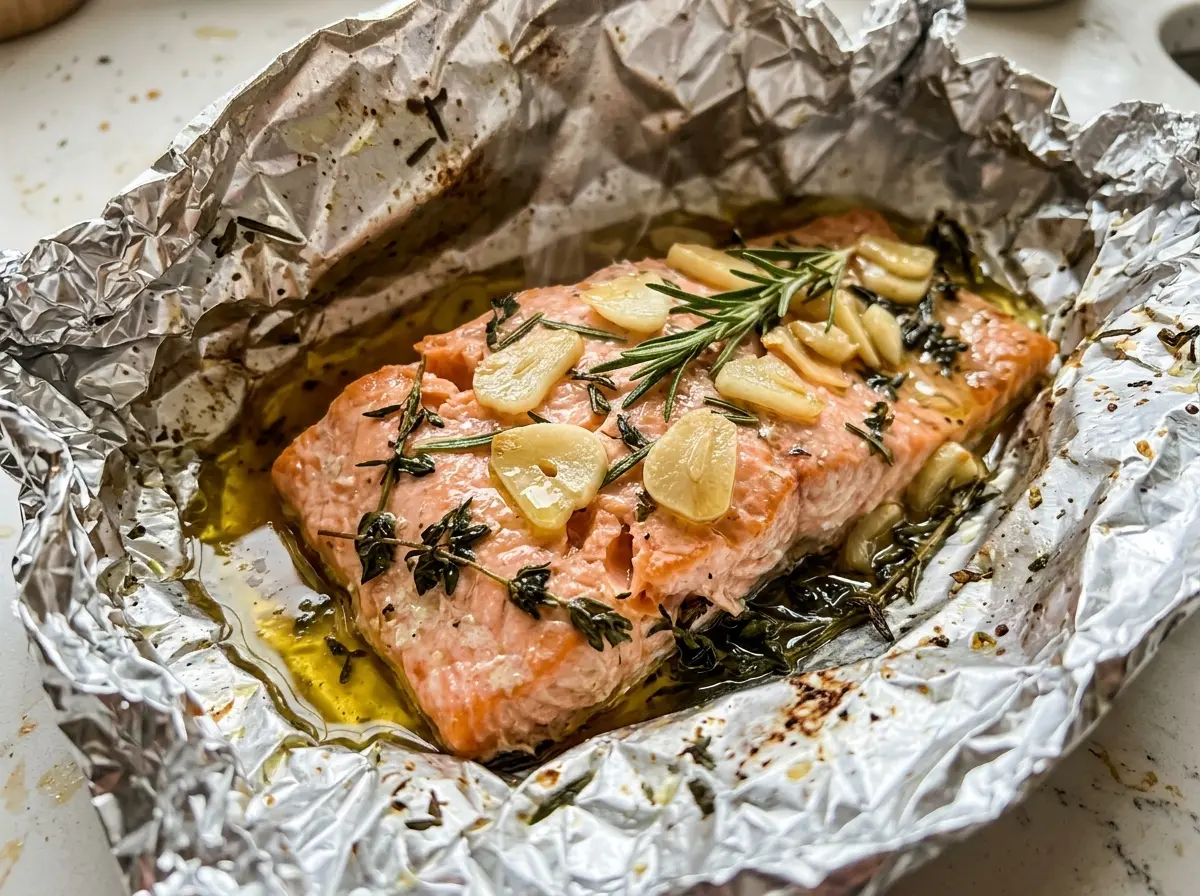
The foil puffs slightly in the oven, and when you open it, garlic and rosemary rise with the steam. That little packet does more than keep the baking sheet clean: it holds the salmon’s moisture close while the fish cooks. For this baked salmon in foil with garlic, rosemary and thyme, the lemon slices sit right on top, adding a bright citrus note as the herbs and garlic season the fillet.
I brush the salmon with olive oil before adding the seasonings so the minced garlic and chopped herbs have something to cling to. A loose foil packet is important here; it should seal around the edges without being pressed tightly against the fish. That gives the salmon room to cook gently while keeping the lemon and seasonings in place.
The method is straightforward, but the thickest part of the fillet—not the clock—is what tells you when it’s ready. Take care when opening the packet, then let the salmon rest before serving. The result is tender fish with fragrant garlic, soft herbs and lemon in every forkful.
Kitchen Note
The first rush of steam is hot, so open the packet slowly and keep your face and hands back from the opening. I use the edge of a fork to lift the foil rather than pulling it toward me.
Save this baked salmon in foil with garlic, rosemary and thyme for a hands-off fish dinner with bright lemon and tender, herb-scented flakes.
Why the Foil Packet Needs Room Above the Salmon
It’s easy to think that pressing the foil close to the fish will keep everything tucked in, but a tight wrap works against the texture you want. The packet should be sealed at the edges and loose over the salmon. That small pocket of air gives the hot, moist environment inside the foil room to circulate around the surface instead of pinning the foil against the fillet.
That setup also keeps the chopped garlic and herbs on the fish rather than letting them slide off as you move the packet. The lemon slices stay in place, too, and their juices mingle with the olive oil as the salmon cooks. You’re not trying to brown the top here; the goal is gently cooked fish that stays moist and takes on the aroma of the ingredients resting over it.
Use heavy-duty foil and fold the edges securely, but don’t crimp the top down onto the salmon. If the packet is stretched tight, it’s harder to open without touching the hot fish, and the foil can stick to the seasonings. A little headroom makes the packet easier to handle and leaves the salmon undisturbed.
Fresh Herbs and Lemon Keep Foil-Baked Salmon Bright
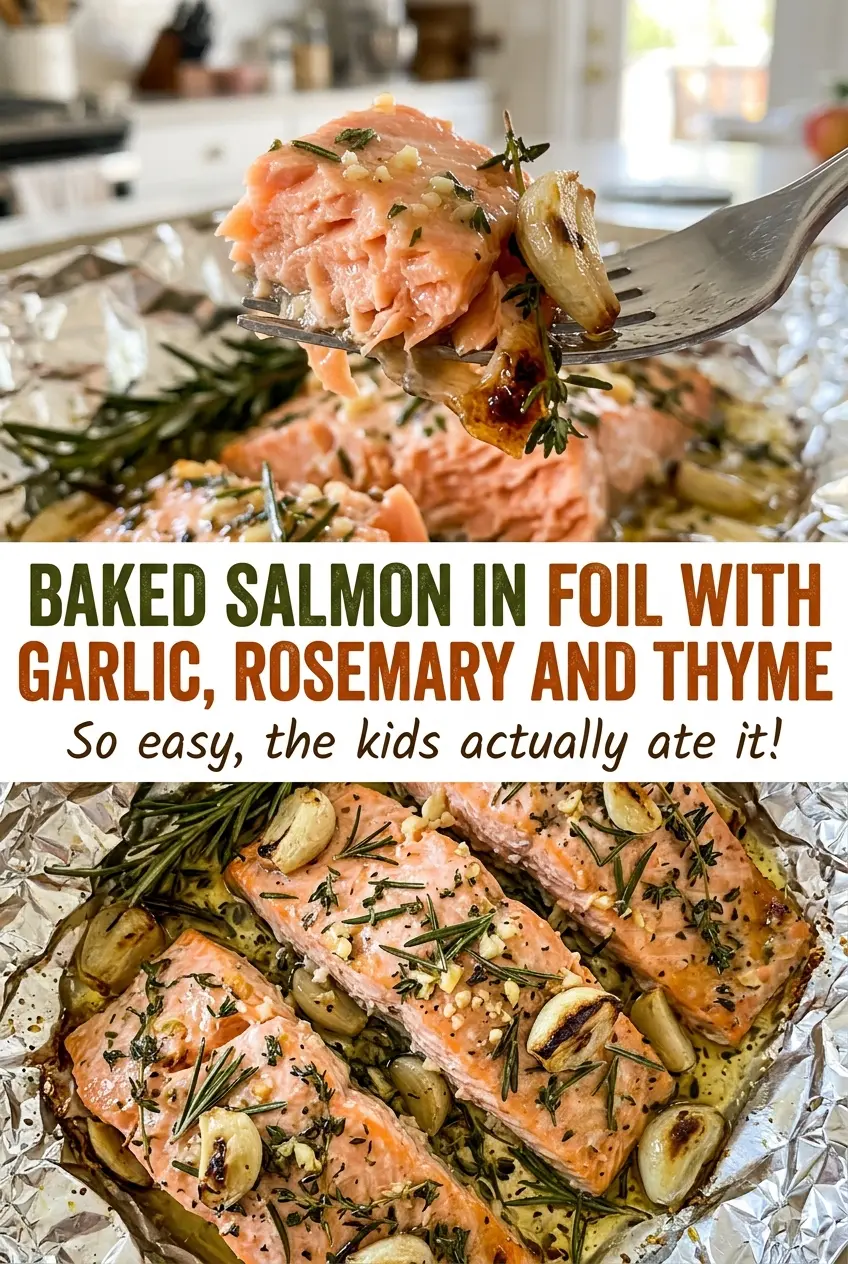
- Salmon — Choose a fillet with an even thickness when you can; it’s easier to cook evenly than a piece that tapers sharply. Skin-on or skin-off both work. If you buy frozen salmon, thaw it in the refrigerator before assembling the packet so it cooks on the same schedule as a thawed fillet.
- Olive oil — It coats the surface and helps the minced garlic and herbs stay put. Regular olive oil is perfectly suitable here; there’s no need to use a costly bottle because the fish is baked with several assertive aromatics. Avocado oil works as a neutral-tasting, one-for-one substitute.
- Garlic — Freshly minced cloves bring a pungent, savory aroma that spreads through the packet. If fresh garlic isn’t available, use garlic powder instead: substitute 3/8 teaspoon for the three cloves, scattering it evenly over the fish.
- Rosemary and thyme — Their woodsy, savory notes complement salmon without needing a sauce. Fresh herbs give the brightest flavor; dried herbs are handy when that’s what you have. Use 1 teaspoon dried rosemary and 1/3 teaspoon dried thyme in place of the fresh herbs, and distribute them evenly so you don’t get a concentrated patch.
- Lemon — Thin slices cover the fish with citrus aroma while the packet bakes. Choose a lemon with an unblemished peel, since the slices rest directly on the salmon. Thinly sliced orange can replace it for a softer, sweeter citrus note.
Build the Foil Packet Without Losing the Seasoning
Set Up the Foil on the Baking Sheet
Heat the oven to 400°F and lay a 24-inch piece of heavy-duty foil on a rimmed baking sheet. Center the salmon on the foil so there’s enough material on every side to fold over and seal. If the fish is off-center, the packet becomes awkward to close and can be harder to lift. Keeping the foil on the baking sheet from the start gives you support when the packet is filled.
Coat and Season the Fillet
Brush olive oil over the salmon, then scatter on the minced garlic, chopped rosemary and thyme, kosher salt and black pepper. Spread the seasonings across the whole top rather than leaving them in one mound. That even layer matters because the packet isn’t stirred during cooking. Finish by arranging the thin lemon slices over the fish.
Seal the Edges, Leave a Little Headroom
Fold the foil over the salmon and bring the edges together to form a loose packet. Crimp the edges closed so the packet holds in steam, but don’t press the foil onto the fish. A little space above the salmon makes it easier to open after baking and keeps the lemon slices from being mashed into the surface. Check that no edge is left gaping before the sheet goes into the oven.
Check the Thickest Part and Let It Rest
Bake the packet for 15 to 20 minutes, then check the thickest part of the salmon with an instant-read thermometer; it should reach 145°F. The center is the best place to check because a thin edge can read hotter before the middle is ready. Once the fish reaches temperature, carefully open the foil and let the salmon rest for 5 minutes before serving. The short rest makes the cooked fillet easier to portion without breaking it apart too soon.
Simple Changes for a Different Citrus or a Lighter Seasoning
Use orange for a sweeter citrus note
Replace the lemon with one thinly sliced orange and arrange the slices over the salmon in the same way. The packet will have a gentler, sweeter citrus aroma and less sharpness than the lemon version.
Make a lower-sodium version
Leave out the kosher salt and keep the garlic, herbs, lemon and black pepper. The salmon will taste less seasoned, but the aromatics still bring plenty of savory character without adding another salt substitute.
Storage and Reheating
- Refrigerator: Store cooked salmon in an airtight container for 3 to 4 days. It will be firmer and less moist after chilling.
- Freezer: Freeze cooled portions in an airtight freezer-safe container for up to 2 to 3 months; the texture may be softer after thawing. Thaw overnight in the refrigerator.
- Reheating: Warm covered portions gently in a 275°F oven until they reach 165°F, checking the center with an instant-read thermometer. High heat can dry the fish before the middle is hot.
Questions That Come Up When Baking Salmon in Foil
Baked Salmon in Foil with Garlic, Rosemary and Thyme
Ingredients
Equipment
Method
- Heat the oven to 400°F.
- Place a 24-inch piece of heavy-duty foil on a rimmed baking sheet.
- Place the salmon in the center of the foil.
- Brush the salmon with olive oil.
- Sprinkle evenly with the garlic, rosemary, thyme, salt, and pepper.
- Arrange the lemon slices over the salmon.
- Fold the foil over the fish and seal the edges to make a loose packet.
- Bake for 15 to 20 minutes, until the thickest part of the salmon reaches 145°F on an instant-read thermometer.
- Carefully open the foil, avoiding the hot steam.
- Let the salmon rest for 5 minutes before serving.