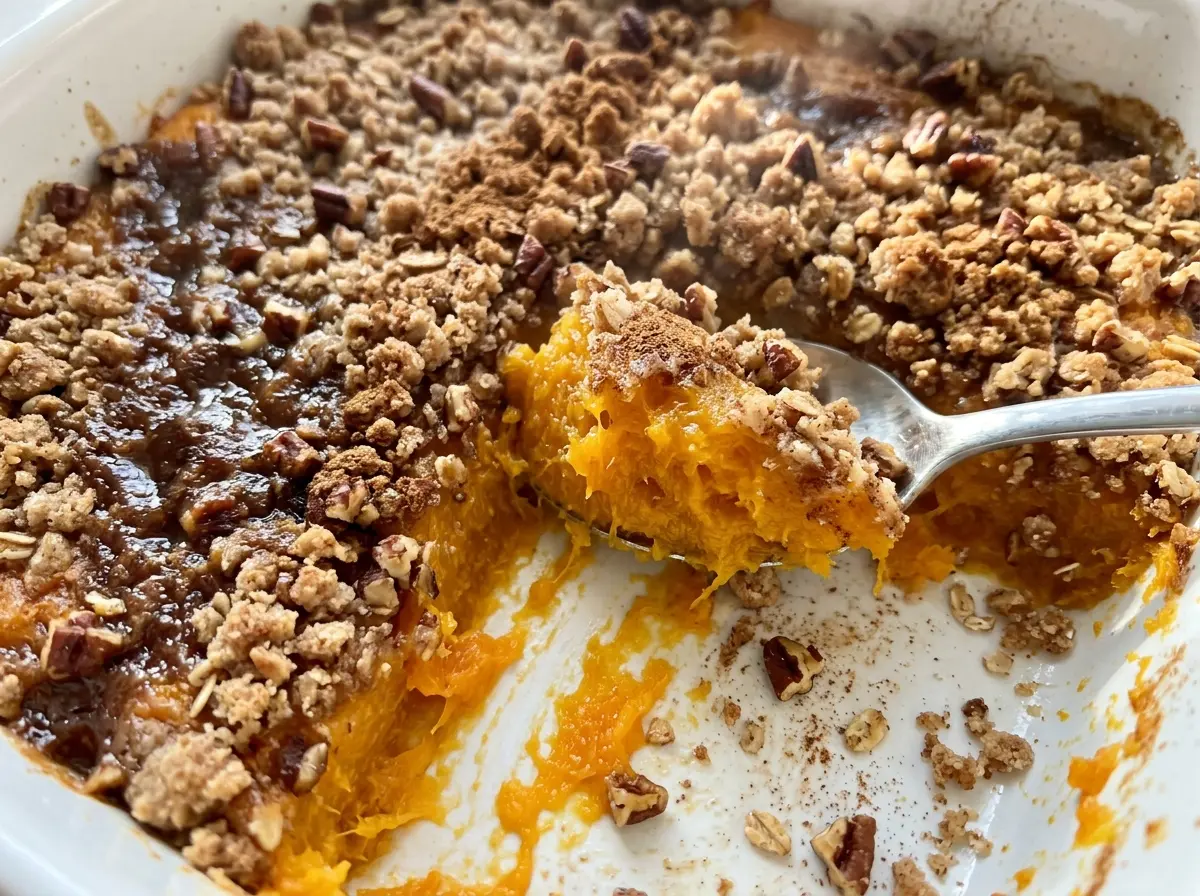
The squash cubes soften and pick up browned edges in the oven, and that roasting step gives this casserole a sweeter, more concentrated base than a pot of boiled squash would. I like that it doesn’t ask for a perfectly smooth puree, either. A few soft pieces give the filling a little body beneath the buttery pecan topping.
For this butternut squash casserole, the squash gets mashed while it’s still warm, then cooled briefly before the eggs go in. That short pause keeps the filling from feeling rushed and gives you time to whisk the sugar, milk, vanilla, and salt together separately. Spread the filling into an 8-inch square dish, scatter on the clumpy topping, and the oven takes it from there: tender squash underneath, golden pecans on top.
Kitchen Note
The topping should look clumpy, not like loose dry flour, before it goes over the squash. Stir until the melted butter has moistened all the flour and sugar, then scatter those little clusters across the surface.
Save this butternut squash casserole for a cozy side dish with roasted squash, a soft vanilla-scented filling, and a crisp pecan topping.
Why This Casserole Shouldn’t Be Mashed Until It’s Completely Smooth
A silky puree sounds appealing, but taking the squash all the way to a uniform paste changes the character of this dish. The filling is meant to be soft and spoonable, with a little texture from the roasted squash beneath the crisp topping. Mash it until most of the larger pieces are gone, then stop when it still looks like squash rather than a perfectly smooth custard.
That texture also helps the topping earn its place. The buttery pecan crumble stays distinct on top, while the filling remains tender instead of turning into one even, pudding-like layer. A potato masher makes it easy to stop at the right point; press and turn through the bowl, checking as you go rather than beating continuously. If a few small pieces remain, that’s exactly the sort of variation that makes each spoonful feel homemade. The eggs and milk bring the filling together during baking, so there’s no need to work the squash into a puree before you add them.
What the Squash, Eggs, and Pecans Each Bring to the Dish

- Butternut squash — Choose a firm squash that feels heavy for its size, with no soft spots. The cubes roast more evenly when they’re close to the same size, and peeled, seeded squash saves a good deal of prep; fresh squash is what gives this filling its roasted sweetness and texture.
- Eggs and whole milk — The eggs help the squash mixture set into a cohesive casserole, while the milk softens the texture and adds richness. Large eggs matter here because the filling relies on them for structure. Lower-fat milk works in a pinch, though the finished filling won’t be quite as rich; a direct egg swap is harder to recommend because it changes how firmly the casserole sets.
- Unsalted butter — Butter enriches both the squash and the crumb topping, and using unsalted butter lets the measured kosher salt season the filling without guesswork. A good everyday butter is fine; there’s no need for a specialty brand. For a dairy-free version, use an unsalted plant-based butter and unsweetened oat milk, knowing the filling and topping will taste a little less buttery.
- Granulated sugar, brown sugar, and vanilla — Granulated sugar sweetens the squash without adding extra moisture, while brown sugar helps the topping form tender, caramel-like clusters. The vanilla rounds out the squash’s earthy sweetness. Use fresh brown sugar that isn’t dried into a hard lump so it mixes evenly with the flour and butter.
- Flour and pecans — All-purpose flour gives the topping its crumbly structure, and chopped pecans add a toasted, buttery crunch. Ordinary all-purpose flour works well here; for a gluten-free adaptation, use a cup-for-cup baking blend made to replace wheat flour. Fresh pecans are worth choosing if yours have been open a long time, since stale nuts can taste flat.
Roast, Mash, and Bake Without Losing the Squash’s Texture
Roast the cubes until fork-tender
Heat the oven to 400°F and toss the squash cubes with olive oil on a rimmed 18×13-inch baking sheet. Spread them out so they roast rather than crowd together, then bake for 25 to 35 minutes, stirring once. They’re ready when a fork slides into a cube easily; if the centers still resist, give them a little more time. Transfer the squash to a large bowl while it’s hot.
Mash and give the squash a short cool-down
Mash the warm squash until it’s mostly smooth, stopping while a little texture remains. Let it cool for 10 minutes before adding the egg mixture. That brief cooling period makes the squash easier to handle and keeps you from combining the eggs with squash straight from the oven. While it rests, reduce the oven temperature to 350°F and grease an 8-inch square baking dish with cooking spray.
Make the filling and clumpy pecan topping
Stir 4 tablespoons of melted butter into the mashed squash. In a separate medium bowl, whisk the granulated sugar, eggs, whole milk, vanilla, and kosher salt until combined, then stir that mixture into the squash. In another medium bowl, mix the flour, packed light brown sugar, chopped pecans, and the remaining melted butter until evenly moistened and clumpy. If flour is still sitting dry at the bottom, keep stirring until the crumbs hold together in small clusters.
Layer the casserole and bake until golden
Spread the squash mixture evenly in the greased dish, then scatter the topping across it so there are pecans in every portion. Bake at 350°F for 30 to 35 minutes, until the topping is golden and the center reaches 160°F. The top should look toasted, not pale, and the filling should be set rather than liquid in the middle. Let the casserole rest for 10 minutes before serving so it settles and is easier to scoop.
Three Simple Ways to Change the Topping
Make the topping gluten-free
Replace the all-purpose flour with the same amount of a cup-for-cup gluten-free baking blend formulated to substitute for wheat flour. Skip almond or coconut flour here; they absorb moisture differently and won’t give you the same clumpy crumble. The topping may be a little more delicate, but it still browns over the squash.
Trade pecans for walnuts
Use the same amount of chopped walnuts in place of the pecans. They give the topping a slightly earthier, less buttery flavor, but they toast well alongside the brown sugar and flour. Chop them to a similar size so they’re easy to scatter evenly.
Use dark brown sugar for a deeper crumble
Swap dark brown sugar for the light brown sugar in the topping, keeping the quantity the same. Its stronger molasses note makes the pecan layer taste darker and more caramel-like, and the crumbs may bake up a touch softer. Watch for the same golden color rather than waiting for a deep brown top.
Storage and Reheating
- Refrigerator: Cover and refrigerate within 2 hours; keep leftovers for 3 to 4 days. The pecan topping softens as it sits against the filling.
- Freezer: Freeze cooled portions in an airtight container for up to 2 months. Thaw in the refrigerator; the topping will lose some crunch but the squash filling freezes well.
- Reheating: Cover loosely with foil and warm in a 325°F oven until the center reaches 165°F. Uncover for the last few minutes if you want to refresh the topping; reheating uncovered the whole time can dry out the edges before the center is hot.
The Questions That Come Up Before This Casserole Goes in the Oven
Butternut Squash Casserole
Ingredients
Equipment
Method
- Heat the oven to 400°F.
- Toss the squash with the olive oil and spread it on a rimmed 18x13-inch baking sheet.
- Roast for 25 to 35 minutes, stirring once, until fork-tender.
- Transfer the squash to a large bowl and mash until mostly smooth.
- Let it cool for 10 minutes.
- Reduce the oven temperature to 350°F.
- Grease an 8-inch square baking dish with nonstick cooking spray.
- Stir 4 tablespoons of the melted butter into the squash.
- In a medium bowl, whisk the granulated sugar, eggs, milk, vanilla, and salt.
- Stir the mixture into the squash until combined.
- Stir the flour, brown sugar, pecans, and remaining 4 tablespoons melted butter in a medium bowl until evenly moistened and clumpy.
- Spread the squash mixture in the prepared dish.
- Scatter the topping evenly over it.
- Bake for 30 to 35 minutes, until the topping is golden and the center reaches 160°F.
- Let the casserole rest for 10 minutes before serving.