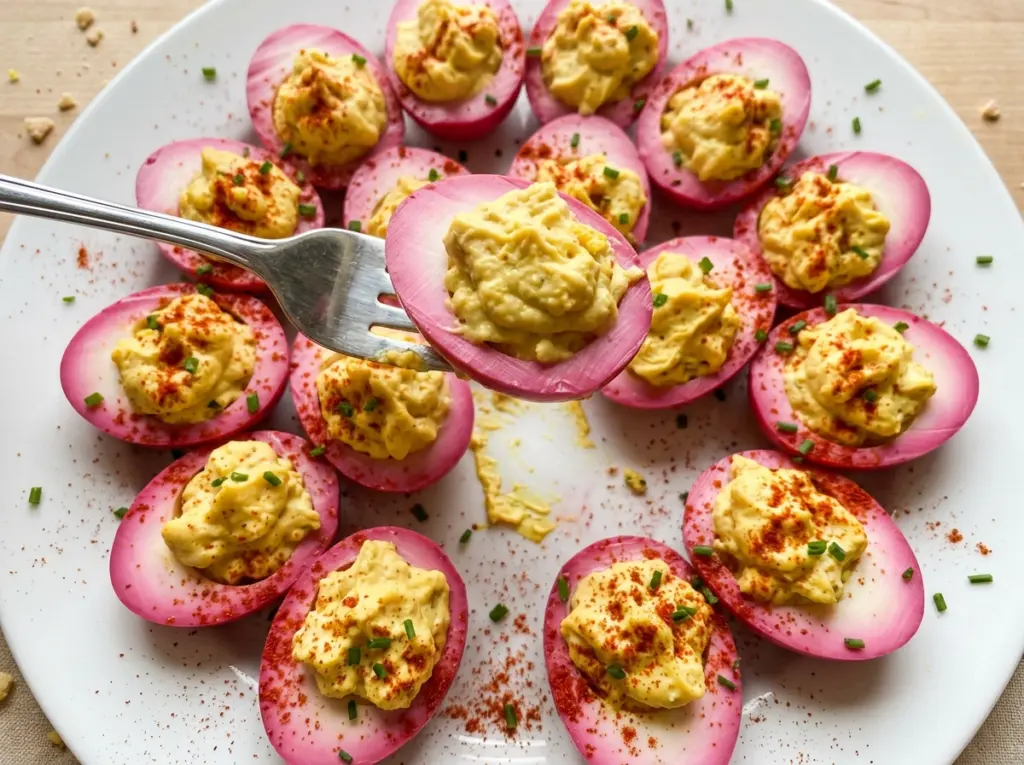

The beets tint the egg whites a bright pink while the yolks stay sunny yellow, and that contrast makes these deviled eggs look special before you’ve even tasted one. I like that the color comes from a quick homemade brine rather than food coloring. The filling stays familiar and savory, with mayonnaise, Dijon, black pepper, and a little paprika on top.
The order matters more than it might seem. I chill the beet brine completely before adding the peeled whites, then keep the yolks separate until the color is where I want it. That gives the whites time to turn pink without staining the creamy filling. The eggs are tender, the centers are smooth, and the finished platter has a clean, vivid color.

Kitchen Note
I set a timer to turn the bag every 30 minutes. It’s an easy detail to forget, and moving the eggs through the brine helps keep the color from concentrating on just one side.
Save these Pink Deviled Eggs for a party platter with bright beet-pink whites and a smooth, paprika-finished filling.
Why the Yolks Stay Out of the Beet Brine
Coloring only the whites gives these eggs their crisp pink-and-yellow look. Once peeled, the whites have a broad surface for the beet brine to tint, while the yolks can wait in a bowl and go straight into the filling. If you brine whole, unpeeled eggs, the shell blocks the color; if you mix the yolks into the filling before the whites are done, the filling can pick up beet color during assembly.
Keeping the two parts separate also lets you control the finished appearance without changing the classic deviled-egg flavor. The brine brings a gentle tang to the outside, while the yolk mixture stays creamy and savory. When the whites have turned bright pink, lift them out of the brine and fill them. The result is a clear color contrast rather than a uniformly pink egg.
What the Beets, Vinegar, and Filling Each Bring

- Canned sliced beets and their liquid — The beets supply the pigment, and the canning liquid gives the brine its base. Use the liquid from the can rather than draining it away; after simmering, press the beets gently to capture their color, then discard the solids. Fresh beets don’t provide the same ready-to-use liquid, so they aren’t a direct swap here.
- White vinegar — Its clean acidity balances the beet sweetness and gives the brine its sharp edge. White vinegar is worth keeping for this recipe; a darker or more strongly flavored vinegar changes the taste and can muddy the pink color.
- Granulated sugar and kosher salt — Sugar rounds off the vinegar, and the salt seasons both the brine and the filling. The salt is divided between those two jobs, so keep some back for the yolks rather than adding it all to the saucepan.
- Large eggs — Large eggs fit the stated cooking time and give you whites sturdy enough to hold the filling. Smaller or larger eggs can cook differently, so stick with large eggs for the most predictable texture.
- Mayonnaise — This gives the mashed yolks their smooth, rich texture. A good everyday mayonnaise works well; there’s no need to reach for a premium brand when Dijon and paprika bring their own flavor.
- Dijon mustard and paprika — Dijon adds a sharp, savory note without taking over the filling. Paprika goes on at the end, where its color and mild warmth finish each egg; sprinkle it over the filled whites rather than mixing it into the yolks.
From Clear Beet Brine to Filled Pink Whites
Simmer the Brine, Then Chill It Completely
Combine the sliced beets with their liquid, white vinegar, sugar, and 1/2 teaspoon of the kosher salt in a 2-quart saucepan. Bring the mixture to a simmer over medium heat and let it simmer for 5 minutes. Strain it into a 1-quart container, pressing the beets gently before discarding the solids. Refrigerate the brine until it’s completely cold, about 1 hour; warm brine can soften the whites instead of giving them a clean color.
Set the Eggs and Cool Them in Ice Water
Put the eggs in a 4-quart saucepan and add 2 quarts cold water. Bring the water to a boil over high heat, cover the pan, and remove it from the heat. Let the eggs stand for 12 minutes, then transfer them to a 2-quart bowl with 1 quart cold water and 2 cups ice for 10 minutes. The covered rest finishes cooking the eggs without keeping them at a boil.
Peel the Eggs and Color the Whites
Peel the cooled eggs and halve them lengthwise, keeping the whites intact as you lift the yolks into a medium bowl. Put the whites in a 1-gallon zip-top bag, pour in the cold beet brine, and seal the bag. Refrigerate for 1 to 2 hours, until the whites are bright pink. Check the color as the eggs soak so you can take them out when they’ve reached the shade you want.
Mash the Filling and Assemble
Mash the yolks with the mayonnaise, Dijon, remaining 1/8 teaspoon of kosher salt, and black pepper until smooth. If you see lumps, keep mashing before you fill the whites; a smooth mixture pipes neatly and is easier to spoon into the narrow egg halves. Spoon or pipe the filling into each white, then sprinkle the tops with paprika. Refrigerate the deviled eggs until you’re ready to serve them.
Three Easy Ways to Adapt These Pink Deviled Eggs
Use Smoked Paprika for a Toastier Finish
Replace the paprika sprinkled on top with smoked paprika. The eggs keep their bright color, but each bite picks up a deeper, lightly smoky note; use the same amount so the garnish doesn’t overpower the filling.
Make the Filling Dairy-Free
Use a dairy-free mayonnaise in place of the regular mayonnaise, keeping the amount the same. The filling stays creamy, though the particular brand may make it a little tangier. The eggs themselves are still part of the dish, so this adaptation is dairy-free, not vegan.
Give the Filling a Sharper Mustard Note
Swap the Dijon for yellow mustard, using it equal-for-equal. The filling will taste more familiar and a little less wine-sharp, while still mixing smoothly with the yolks and mayonnaise.
Make-Ahead and Serving
- Refrigerator: Keep the assembled eggs covered and refrigerated. They’re at their best within 2 days.
- Freezer: Don’t freeze them; cooked egg whites turn watery and rubbery, and the yolk filling can separate as it thaws.
- Serving: Serve chilled, and don’t leave the eggs at room temperature for more than 2 hours.
Questions About Coloring and Filling Deviled Eggs
Pink Deviled Eggs
Ingredients
Method
- Combine the beets and their liquid, vinegar, sugar, and 1/2 teaspoon salt in a 2-quart saucepan.
- Bring to a simmer over medium heat and simmer for 5 minutes.
- Strain into a 1-quart container, pressing the beets gently, and discard the solids.
- Refrigerate the brine until completely cold, about 1 hour.
- Place the eggs in a 4-quart saucepan and add 2 quarts cold water; bring to a boil over high heat.
- Cover, remove from the heat, and let stand for 12 minutes.
- Transfer the eggs to a 2-quart bowl with 1 quart cold water and 2 cups ice for 10 minutes.
- Peel the eggs, halve them lengthwise, and transfer the yolks to a medium bowl.
- Put the whites in a 1-gallon zip-top bag, pour in the cold brine, and seal.
- Refrigerate for 1 to 2 hours, turning the bag every 30 minutes, until the whites are bright pink.
- Mash the yolks with the mayonnaise, Dijon, remaining 1/8 teaspoon salt, and black pepper until smooth.
- Spoon or pipe the mixture into the egg whites.
- Sprinkle with paprika.
- Refrigerate the deviled eggs until ready to serve.