At the oven’s first high heat, the edge of the pumpkin filling begins to set before the longer, gentler bake finishes the center. That’s what gives Pumpkin Pecan Pie a custardy slice instead of a dry, firm one. I like the contrast of the spiced pumpkin underneath a buttery pecan topping, with a little crunch in every bite.
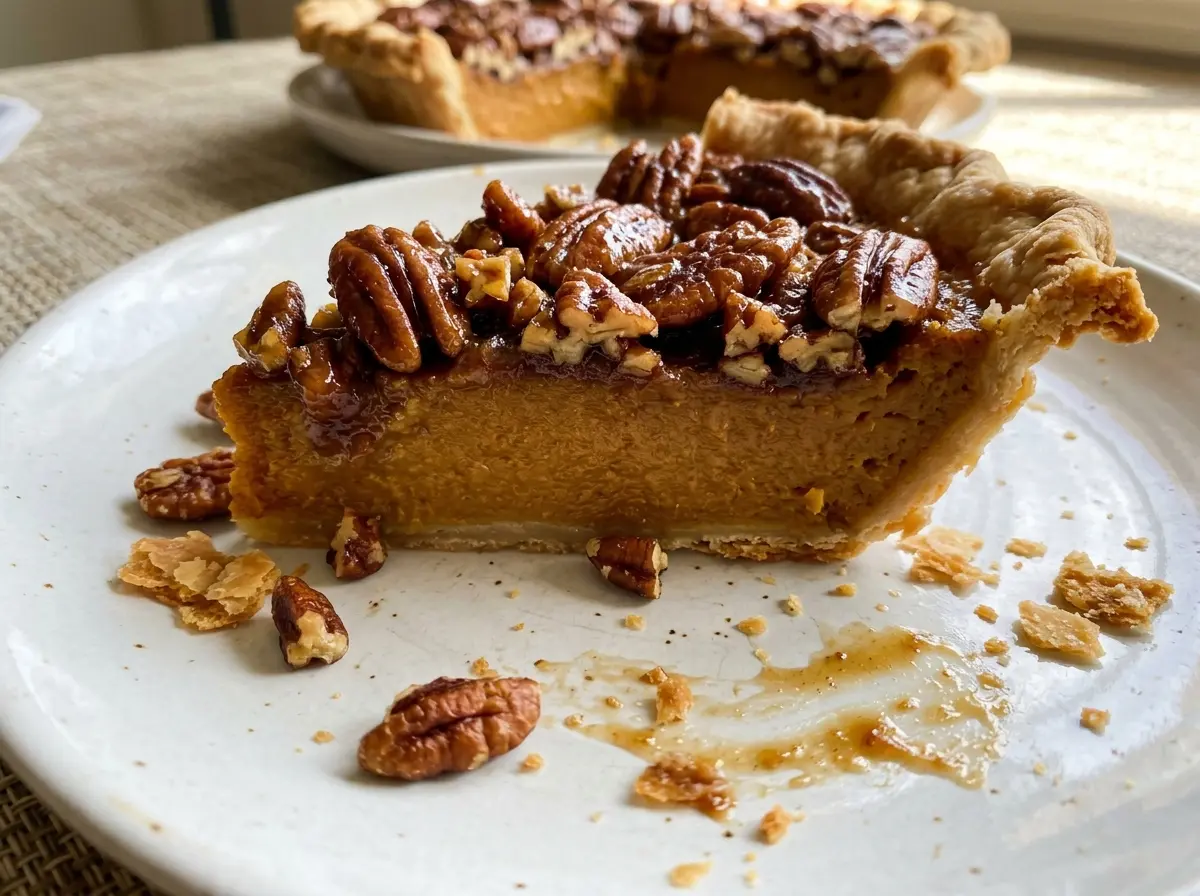
The two parts need different timing: the pumpkin pie cools on its own, and the pecan topping cooks on the stove. I’ve found that keeping those stages separate gives the topping a chance to sit neatly over the filling rather than blending into it. The finished pie has a smooth, gently spiced center and a sweet pecan layer that catches the light.
Kitchen Note
Crimp the crust while the pie plate is still empty. Once the pumpkin filling is in, shaping the edge is awkward and can slosh filling over the rim.
Save this Pumpkin Pecan Pie for its spiced custard, glossy brown-sugar topping, and crunchy pecans.
Why the Pecan Topping Goes on a Cool Pumpkin Pie
The pecan layer is a cooked brown-sugar topping, not part of the oven bake. It goes over the pumpkin custard after the pie has cooled, so the two layers stay distinct. If the filling is still warm, the buttery topping can loosen as soon as it lands and sink into the surface instead of setting as a separate cap.
That contrast is what makes this pie feel different from a plain pumpkin pie: a smooth, gently spiced center under a sweet topping with chopped pecans throughout. The topping also firms as it rests, so it’s easier to cut once it has had time to set. Keep the topping and filling in their own stages, and you’ll get a clean finish without baking the pecans into the custard.
The cooling time can feel like the longest part, but it gives the pumpkin filling time to settle before the topping goes on. I set up the saucepan and serving spoon while the pie cools, then finish the topping right before spreading it. That way, the warm caramel mixture is easy to spoon over the pie instead of turning stiff in the pan.
How Pumpkin Puree and Evaporated Milk Shape the Filling

- Pumpkin puree — Plain canned puree gives the custard its pumpkin flavor and body. Use puree rather than a pre-sweetened pumpkin pie mixture, which would bring its own sugar and spices and throw off the balance. A smooth puree is what you want; there’s no need to add extra liquid.
- Evaporated milk — This brings a concentrated, creamy quality to the filling without making it watery. It isn’t the same as sweetened condensed milk, and swapping in regular milk changes the filling’s richness and consistency. Use the canned evaporated milk for the texture this pie is built around.
- Eggs — The eggs help the pumpkin mixture set into slices instead of staying loose. Whisk them thoroughly into the pumpkin and sugar before adding the milk so the filling starts out even, with no streaks of egg white.
- Cinnamon, ginger, and cloves — Together, these spices give the pumpkin filling its familiar warm aroma. Ground spices that smell fragrant when you open the jar will come through more clearly than spices that have been sitting open for a long time.
- Refrigerated pie crust — An unbaked crust fits the timing of this filling and bakes along with it. Fit it into the 9-inch pie plate before pouring so the edge is ready and the crust stays supported.
- Light brown sugar, butter, heavy cream, and corn syrup — These cook into the topping that holds the chopped pecans. The corn syrup helps the sugar mixture stay smooth, while the cream and butter give it a rich, spoonable texture; keep these ingredients together rather than trying to simplify the topping.
- Chopped pecans — The pieces give the topping its crunch and make each slice easy to cut. Fresh-tasting pecans matter here because they’re the most noticeable flavor in the topping once it’s cooked.
From Unbaked Crust to a Set Pecan Top
Fit and Crimp the Crust Before Filling
Heat the oven to 425°F. Fit the unbaked refrigerated crust into a 9-inch pie plate and crimp the edge as you like while the plate is still empty. Set the pie plate on a rimmed baking sheet before adding the filling. The sheet gives you a steady surface to move and catches any drips.
Whisk the Pumpkin Custard Smooth
In a large bowl, whisk the pumpkin puree with the eggs, granulated sugar, cinnamon, ginger, cloves, and salt. Keep whisking until the mixture looks smooth, with the spices evenly dispersed rather than clumped in one spot. Whisk in the evaporated milk after that, then pour the filling into the crust. Avoid splashing filling onto the pastry edge, where it can bake onto the crust.
Bake Until the Center Still Has a Little Movement
Bake for 15 minutes at 425°F, then reduce the oven temperature to 350°F without removing the pie. Continue baking for 40 to 50 minutes, until the edges look set and the center wobbles slightly. Check that the center reaches 160°F. Don’t wait for the whole surface to look firm; the center should still move a little at this stage.
Cool the Pie Before Making the Topping
Move the pie to a wire rack and let it cool to room temperature, about 2 hours. In a small saucepan, combine the brown sugar, butter, heavy cream, and light corn syrup, then cook over medium heat, stirring, until bubbling. Let it boil for 1 minute, then take the pan off the heat and stir in the chopped pecans. Spoon the topping evenly over the cooled pie right away, while it’s still easy to spread.
Give the Pecan Layer Time to Set
Leave the topped pie undisturbed for 20 minutes before serving. The topping firms during this short rest, so it won’t run across the surface when you slice. If you cut into it too soon, the caramel layer may still be soft and pull away from the pecans. Once set, the top has a glossy finish and a pleasant bite.
Two Ways to Change the Pecan-Pie Finish
A pecan-free caramel topping
For a pecan-free version, leave the chopped pecans out and cook the remaining topping ingredients together as usual. The result is a smooth caramel cap rather than a crunchy one. If you’re avoiding pecans because of an allergy, prevent cross-contact with your ingredients, pan, and serving utensils.
Classic pumpkin pie without the topping
Skip the stovetop topping if you want the pumpkin custard to be the whole story. The pie keeps its spiced, creamy center but loses the extra sweetness and pecan crunch. This is the simplest way to make a less-rich version without changing the filling.
Storage and Reheating
- Refrigerator: Cover and refrigerate leftovers for 3 to 4 days. The crust softens a little, and the topping loses some of its crunch.
- Freezer: Freeze wrapped slices in an airtight container for up to 1 month. Thaw them in the refrigerator; the topping may be softer after thawing.
- Reheating: Reheating isn’t necessary; serve the pie chilled or at room temperature. Microwaving can soften the crust and make the topping sticky.
Questions That Come Up When Baking Pumpkin Pecan Pie
Pumpkin Pecan Pie
Ingredients
Equipment
Method
- Preheat the oven to 425°F and fit the pie crust into a 9-inch pie plate, crimping the edge as desired; set the plate on a rimmed baking sheet.
- In a large bowl, whisk the pumpkin, eggs, granulated sugar, cinnamon, ginger, cloves, and salt until smooth, then whisk in the evaporated milk.
- Pour the filling into the crust and bake for 15 minutes at 425°F, then reduce the oven to 350°F and bake for 40 to 50 minutes, until the edges are set and the center wobbles slightly; check that the center reaches 160°F.
- Cool the pie on a wire rack until it reaches room temperature, about 2 hours.
- Combine the brown sugar, butter, heavy cream, and corn syrup in a small saucepan and cook over medium heat, stirring, until bubbling; boil for 1 minute.
- Remove the pan from the heat, stir in the pecans, and immediately spoon the topping evenly over the cooled pie.
- Let the topping set for 20 minutes before serving.


