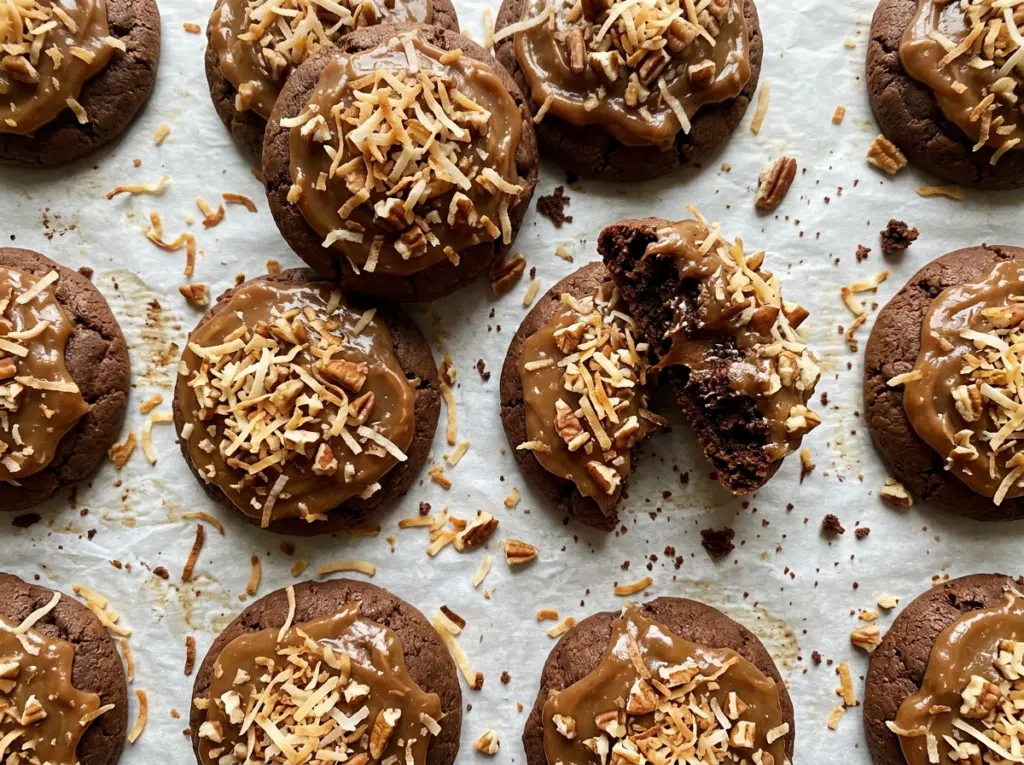

When the chocolate cookies come out of the oven, the centers can look softer than you expect. I used to wait for them to look fully firm, then ended up with dry cookies once they cooled. For these German Chocolate Cookies, the edges should be set and the centers just dry; a short rest on the baking sheet finishes the job without baking away their soft texture.
The coconut-pecan topping is cooked separately, more like a quick custard than a frosting. Egg yolks thicken the evaporated milk and sugar, and the topping firms further as it cools. Give it time to become spreadable before it goes onto the cookies, and you’ll get a generous layer that stays put rather than running over the edges. The finished cookies have a tender cocoa base under a sweet, chewy coconut topping with pecans in every bite.
Kitchen Note
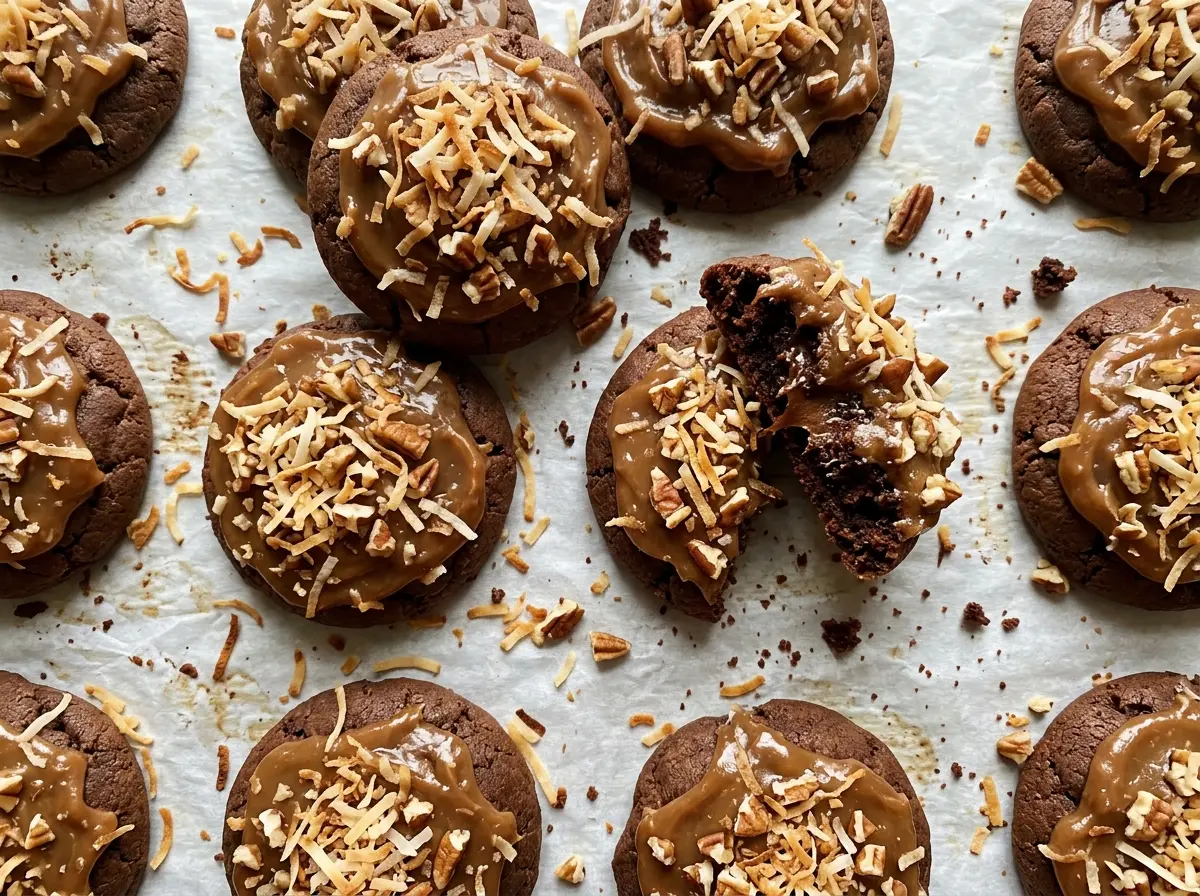
Leave about 2 inches between the scoops on each pan. That little bit of breathing room keeps the cookies from baking into one another, so every edge stays neat when you spread on the topping.
Save these German Chocolate Cookies for a bake with tender cocoa cookies and a thick coconut-pecan topping.
Why the Coconut-Pecan Topping Needs Time to Set
This topping isn’t a frosting that thickens just from mixing. It’s a cooked custard: the egg yolks give the evaporated milk body, while the sugar and butter make it rich enough to spread over the cocoa cookies. Cook it until it coats the back of a spoon, then let it cool until it holds its shape. If you try to judge its final thickness while it’s hot, it will seem looser than it will be once it settles.
That cooling time also helps the topping stay on the cookie instead of soaking into a warm surface. The cookies need to be completely cool before you add it, and the topping should be thick and spreadable rather than warm and pourable. You’ll get a defined layer with coconut and pecans throughout, not a puddle at the edges. It’s worth letting both parts reach the right texture before assembling.
What the Cocoa, Evaporated Milk, and Egg Yolks Each Bring

- Unsweetened cocoa powder — This gives the cookie its deep chocolate taste without adding sugar. A standard grocery-store cocoa works well; keep it unsweetened so the dough’s sugar stays in balance, and whisk it with the flour to break up lumps before mixing.
- Unsalted butter — Softened butter creams with the sugar and helps the cookies bake up tender, while the portion stirred into the topping adds richness. Let the cookie portion soften until it yields when pressed but isn’t shiny or melted; an everyday butter is fine here.
- Evaporated milk and egg yolks — Together they form the topping’s custard base. Evaporated milk is concentrated and unsweetened, while yolks thicken the mixture; sweetened condensed milk isn’t an equivalent swap because it brings extra sugar and a much thicker consistency.
- Sweetened flaked coconut — The sweetened flakes bring chew and sweetness to the topping. They’re the right choice for the classic taste here; unsweetened flakes will make the topping less sweet and a little less tender.
- Pecans — Chopped pecans add the buttery crunch that makes this topping recognizable. Freshness matters more than brand, since stale nuts can taste flat; chopped walnuts are the closest swap and can be used in the same amount.
- All-purpose flour — Flour gives the cocoa dough enough structure to hold its shape around the topping. Spoon it into the measuring cup and level it rather than packing it in, which keeps the cookies from turning heavy.
From Soft Cookie Dough to a Spreadable Coconut-Pecan Finish
Cream the Butter and Build the Cocoa Dough
Beat the softened butter and cookie sugar with an electric mixer on medium speed until the mixture looks light and fluffy, about 2 minutes. Add the eggs one at a time, then mix in the vanilla. Whisk the flour, cocoa, baking soda, and salt in a separate bowl before adding them to the butter mixture. Stop mixing as soon as no dry streaks remain; beating beyond that point can make the cookies tougher.
Chill, Scoop, and Space the Portions
Cover the dough and refrigerate it for 30 minutes so it’s easier to portion and handle. Scoop it into 24 portions of about 2 tablespoons each, then arrange 12 on each parchment-lined 18×13-inch baking sheet. Keep the portions evenly sized so they bake at the same pace. Leave room around each one for the cookies to spread.
Bake Until the Edges Set
Heat the oven to 350°F and bake the sheets for 10 to 12 minutes, swapping them between racks halfway through. Look for set edges and centers that appear just dry; don’t wait for the centers to look crisp. Leave the cookies on the sheets for 5 minutes before transferring them to a rack to cool completely. They’ll be delicate when hot, so moving them too soon can break them.
Cook the Topping Without Letting It Boil
In a 2-quart saucepan, whisk the evaporated milk, topping sugar, and egg yolks until smooth, then stir in the butter. Cook over medium heat for 8 to 12 minutes, stirring constantly, until the mixture reaches 170°F and coats the back of a spoon. Keep it moving across the bottom of the pan, where it can catch first. Don’t let the custard boil.
Cool and Top the Cookies
Take the saucepan off the heat and stir in the vanilla, coconut, and pecans. Let the topping cool for about 30 minutes, until it’s thick enough to spread without running. Spoon about 1 1/2 tablespoons onto each completely cooled cookie and gently spread it to the edges. A light touch keeps the soft cookie from tearing under the topping.
Simple Changes for a Different Batch of German Chocolate Cookies
Use a Cup-for-Cup Gluten-Free Flour Blend
Replace the all-purpose flour with a cup-for-cup gluten-free baking blend made for cookies. The cocoa base may have a slightly different crumb depending on the blend, but the topping and assembly stay the same.
Make the Topping Less Sweet
Swap the sweetened flaked coconut for unsweetened flaked coconut. The topping will taste less sweet and may feel a touch less tender, but the pecans and custard still give it the familiar coconut-pecan character.
Make a Dairy-Free Batch
Use unsalted plant-based baking sticks in place of the butter and evaporated coconut milk in place of the evaporated milk, using the same amounts. The cookies will have a more pronounced coconut note, and the topping may be a little softer; the eggs remain in the recipe.
Storage and Reheating
- Refrigerator: Store the topped cookies in an airtight container for 3 to 4 days. The chilled topping firms up, and the cookie base will be a little firmer than it is at room temperature.
- Freezer: Freeze the plain baked cookies in an airtight container for up to 2 months, then thaw and add freshly made topping. The assembled cookies aren’t ideal for freezing because the custard-style topping can soften or weep as it thaws.
- Reheating: These don’t need reheating. Let only the cookies you plan to eat sit out briefly; microwaving can loosen the topping and make it slide.
Questions That Come Up While Making These Cookies
German Chocolate Cookies
Ingredients
Equipment
Method
- Heat the oven to 350°F and line two 18x13-inch baking sheets with parchment paper.
- In a large bowl, beat 1 cup softened butter and 1 1/2 cups sugar with an electric mixer on medium speed until light and fluffy, about 2 minutes.
- Beat in the eggs one at a time.
- Beat in 1 teaspoon vanilla.
- In a separate bowl, whisk together the flour, cocoa powder, baking soda, and salt.
- Mix the dry ingredients into the butter mixture just until no dry streaks remain.
- Cover the dough and refrigerate for 30 minutes.
- Scoop the dough into 24 portions, about 2 tablespoons each.
- Arrange 12 portions on each prepared baking sheet, spaced about 2 inches apart.
- Bake for 10 to 12 minutes, swapping the sheets between racks halfway through, until the edges are set and the centers look just dry.
- Cool the cookies on the sheets for 5 minutes.
- Transfer the cookies to a rack to cool completely.
- In a 2-quart saucepan, whisk the evaporated milk, 1 cup sugar, and egg yolks until smooth.
- Stir in 1/2 cup butter.
- Cook over medium heat, stirring constantly, for 8 to 12 minutes, until the mixture reaches 170°F and thickens enough to coat the back of a spoon; do not let it boil.
- Remove the pan from the heat.
- Stir in 1 teaspoon vanilla, the coconut, and pecans.
- Let the topping cool until thick and spreadable, about 30 minutes.
- Spoon about 1 1/2 tablespoons of topping onto each cooled cookie and spread it gently to the edges.